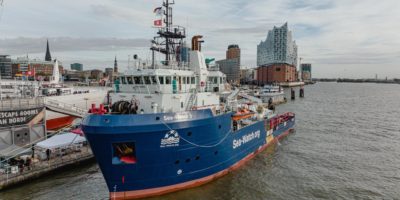
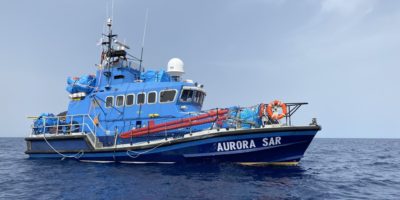

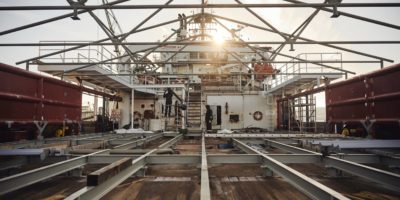

Berlin, 7 May 2026. For the first time since the beginning of civilian search and rescue operations in the central Mediterranean in 2015, the German Government has extended Security Level 2 for vessels flying the German flag from Libyan territorial waters to also include the Libyan search and rescue zone off the Libyan coast – the operational area of search and rescue organisations such as SOS Humanity and Sea-Watch.
The non-governmental organisations whose rescue vessels fly the German flag received this information on Tuesday from the German Maritime Security Centre. According to this, the tightening of the security warning was only issued on Monday, 4 May 2026, by the Ministry of the Interior, even though people on the move have been subjected to systematic violence for years and attacks on rescue vessels had already escalated with the shooting at the civilian rescue ship Ocean Viking in August 2025.
“The Ministry of the Interior’s recognition of violence by Libyan actors at sea comes very late,” criticises Marie Michel, policy expert at SOS Humanity. “For many years, SOS Humanity and Sea-Watch have pointed out – and repeatedly documented – the violence and human rights violations committed by the so-called Libyan coast guard, which is financed by the EU and its Member States. It is now urgently necessary that this recognition be followed by political consequences: concrete protection for rescue vessels and an end to support for those actors responsible for the dangerous situation.”
While Security Level 2 is now being extended not only to the wider search and rescue zone but also to the smaller exclusive economic zone, the Ministry of the Interior assesses that, alongside commercial vessels, civilian rescue ships in particular are at risk.
“The German Government is thus confirming a central contradiction in its own policy,” explains Marie Naaß, Head of Political Communications at Sea-Watch. “It acknowledges the real danger posed by the so-called Libyan coast guard while at the same time continuing to support it. The current governing coalition has even made it possible once again to train the so-called Libyan coast guard, instead of clearly opposing it. In doing so, the government is tacitly complicit in the recognised security problem and the violence.”
Last year, the German Government adapted and approved the extension of the EU naval mission EUNAVFOR MED Irini in such a way that training of the so-called Libyan coast guard by German Bundeswehr personnel is no longer excluded.
In its response to a parliamentary inquiry by the Green Party in spring 2023, the government had already described Libya’s fragmented security architecture, the absence of a monopoly on the use of force, and the links between the so-called Libyan coast guard and human traffickers in Libya.
Within the framework of European cooperation – including German participation – rescue coordination centres and the Libyan coast guard have been established and equipped in recent years to enable the forced return (“pullbacks”) of people on the move, which are considered to be in violation of international law. Plans are currently underway to expand another rescue coordination centre in Benghazi in eastern Libya, an area under the control of military commander Khalifa Haftar. According to calculations by SOS Humanity, more than €84 million in EU funds have been allocated to these forms of cooperation since 2017.
SOS Humanity and Sea-Watch, two organisations that have been active in civilian search and rescue in the central Mediterranean for the past ten years, call on the German Government to immediately end the training of the illegitimate Libyan coast guard, or to exert influence within the EU to cease its funding, and to ensure sustainable protection for civilian search and rescue operations.