Dutch government blocks Sea-Watch 3 and other NGO ships with a new policy, citing concerns for ‘safety,’ while people are left to drown
4 min read

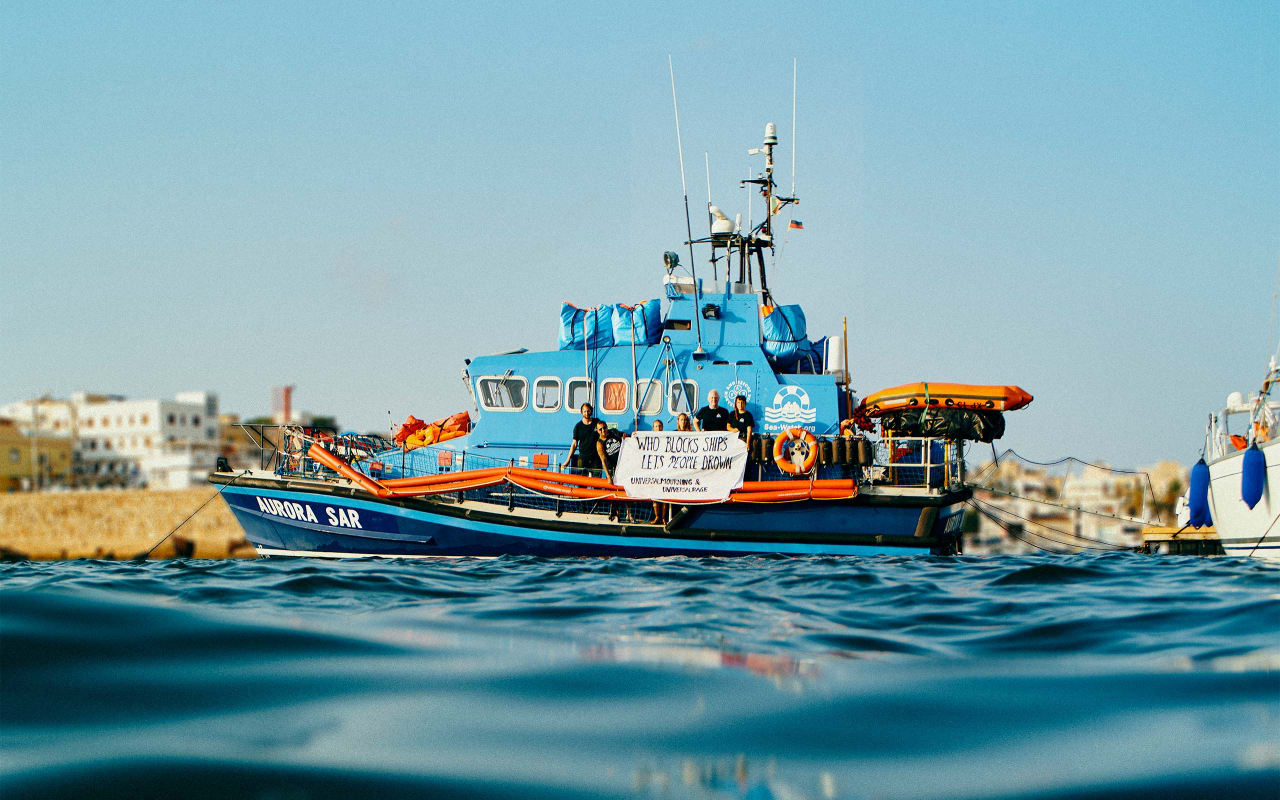
Today, a new policy imposed by the Dutch Ministry of Infrastructure and Water Management will take effect, which has severe implications on Sea-Watch and other NGOs operating ships under the Dutch flag.
The policy change implemented hastily and without a transition period for Sea-Watch, demonstrates the lengths the Dutch government is willing to go to, to hinder civil society actors from their operations – a strategy it shares with other EU member states, abusing their powers in a coordinated crackdown on Mediterranean rescue operations. Internal communication between Dutch ministries, revealed under the Freedom of Information Act, shows that safety concerns have never been the driving force for this policy change, but rather that it is part of the European repertoire of tactics to hinder civil Search and Rescue.
After finalising planned maintenance and successfully passing yet another inspection on 15 March, the Sea-Watch 3 was supposed to sail back to the SAR zone on 17 March. However, the Flag State’s intention to prevent this from happening at all cost is undeniable.
Until the time the Dutch government is satisfied that we comply with more stringent technical requirements under the new regulation, Sea-Watch is forced to suspend its current mission and will be subjected to another series of farcical regulatory processes. “It is beyond comprehension that our own Flag State attempts to undermine our work, while we consistently demonstrate that we have an extremely well-equipped rescue vessel that exceeds mandatory safety standards; a fact the Dutch ‘Inspectie Leefomgeving en Transport’ [Human Environment and Transport Inspectorate] itself concluded in a thorough five-year inspection of our ship last summer, when it was unlawfully held in the Maltese port of Valletta,” says Johannes Bayer, chairman of Sea-Watch.
The Ministry claims to have ‘safety concerns’ for shipwrecked guests Sea-Watch may get on board. “We cannot be held accountable for the current state of inhumane standoffs at sea. Instead, this situation is a damning indictment of certain European states who are abusing their powers. In any next rescue, another long standoff may be likely, but still unacceptable. Blocking us for ‘safety’ concerns in a standoff is a fundamentally illogical argument when the alternative is that people are left to drown.”, says Bayer. Keeping shipwrecked people at sea for prolonged periods of time is in violation of international law and therefore will never be the responsibility of Sea-Watch or any vessel rendering assistance to a distress case. It is the legal obligation of maritime rescue coordination authorities to provide a safe port without delay.
Under the Dutch Freedom of Information Act, Sea-Watch gained insight into the historical process underlying this policy change. The information obtained confirmed our arguments that safety has not been the priority for the Dutch government in relation to NGO ships flying its flag and who rescue migrants. When the Cabinet called an urgent consultation with the Ministries of Justice and Infrastructure a week before the EU Summit on Migration in June last year, the objective was clearly to find new ways to regulate NGO ships in the context of migration policy. Until today, there have been no safety concerns or incidents in NGO SAR operations which could have prompted this process. The political and cynical nature of the new policy is further confirmed by the fact that each proposal for new regulations was shared with the Directorate Migration Policy at the Ministries of Justice and Foreign Affairs for approval, which clearly has no mandate or contribution in the question of ship safety.
While our operation to the new but inapplicable policy framework should not even a point of contention, Sea-Watch will continue to be able and willing to guarantee safety and certification compliance. However, Sea-Watch continues to call for the Dutch government to pass through the proper channels of a comprehensive legislative change for ships of our classification. It is highly concerning that instead, a rushed policy change has been pushed onto Sea-Watch and other NGOs, with no notice. There is no guarantee that the Ministry will not impose more policy changes so arbitrarily in the future. Sea-Watch calls into question the legitimacy of this process and the underlying motives of the Dutch state; to drown us in technical and bureaucratic superficialities while people continue to drown at sea?
Here you can find a summarized and commented version of the information we received through the Dutch Freedom of Information Act as well as the original file: Dropbox-Link.
Subscribe to our Newsletter