23 000 Lives

Why you should support Sea-Watch now

People are still dying in the Mediterranean. Every day.

After seven years, all charges were dropped. But the Iuventa was destroyed during the seizure. She rusted in the port of Trapani and was returned as a wreck in 2024. Jugend Rettet (Youth to the Rescue) is pursuing legal action to seek compensation for the damaged and looted vessel.

The criminal proceedings against the Iuventa crew are over, but people are still dying in the Mediterranean without pause. That is why Sea-Watch’s vessels are still operating in the same waters where the Iuventa once sailed.

Sea-Watch and the Iuventa crew share the same values and work as allies. Jugend Rettet activists and Iuventa crew members have become an active part of Sea-Watch: as crew members on board the ships or in the organisation’s work on land.

Your donation supports Sea-Watch’s current rescue operations in the Mediterranean. At the same time, a portion of donations goes to the Iuventa crew to cover the costs of the trial and fund their ongoing work.

The Iuventa was not a film set, she was a living part of our civilian fleet. Operated by more than 200 volunteers, she was involved in the rescue of over 23,000 people. Then the vessel was seized by Italian authorities and the crew was charged with “facilitation of unauthorized entry.”

The trial became a spectacle and established a new narrative: those who helped were no longer seen as rescuers, but as criminals. The case is emblematic of a Europe-wide development: the systematic criminalisation of migration and solidarity.

After seven years, all charges were dropped. But the Iuventa was destroyed during the seizure. She rusted in the port of Trapani and was returned as a wreck in 2024. Jugend Rettet (Youth to the Rescue) is pursuing legal action to seek compensation for the damaged and looted vessel.

The criminal proceedings against the Iuventa crew are over, but people are still dying in the Mediterranean without pause. That is why Sea-Watch’s vessels are still operating in the same waters where the Iuventa once sailed.

Sea-Watch and the Iuventa crew share the same values and work as allies. Jugend Rettet activists and Iuventa crew members have become an active part of Sea-Watch: as crew members on board the ships or in the organisation’s work on land.

Your donation supports Sea-Watch’s current rescue operations in the Mediterranean. At the same time, a portion of donations goes to the Iuventa crew to cover the costs of the trial and fund their ongoing work.

The Iuventa was not a film set, she was a living part of our civilian fleet. Operated by more than 200 volunteers, she was involved in the rescue of over 23,000 people. Then the vessel was seized by Italian authorities and the crew was charged with “facilitation of unauthorized entry.”

Based on a true Story Reality

Original documents, court transcripts, nautical charts, witness statements – for everyone who wants to know more than Netflix shows: Visit the Iuventa website for background information

The criminal proceedings against the Iuventa crew are over, but people are still dying in the Mediterranean without pause. That is why Sea-Watch’s vessels are still operating in the same waters where the Iuventa once sailed.

Sea-Watch and the Iuventa crew share the same values and work as allies. Jugend Rettet activists and Iuventa crew members have become an active part of Sea-Watch: as crew members on board the ships or in the organisation’s work on land.

Your donation supports Sea-Watch’s current rescue operations in the Mediterranean. At the same time, a portion of donations goes to the Iuventa crew to cover the costs of the trial and fund their ongoing work.

If you want to help after watching the film:
here’s how.

Sea-Watch, alongside Jugend Rettet, was one of the first civilian sea rescue organisations in the Mediterranean. Today we operate three rescue vessels there and have been involved in the rescue of over 50,000 people since 2015. Our crew is there when boats are in distress – regardless of nationality or origin.

But our work, too, is repeatedly criminalised. After Libyan militias opened fire on our crew and rescued people in May, Italian authorities are now investigating our Sea-Watch 5 captain – also for “facilitation of unauthorized entry.”

What the film shows remains a bitter reality to this day.

Support our missions and our fight for solidarity at sea now.

Your donation helps save lives.

Zwei Personen von Sea-Watch befinden sich wenige Meter vor einem Seenotrettungsfall und statten Menschen mit Rettungswesten aus.

Sea-Watch, alongside Jugend Rettet, was one of the first civilian sea rescue organisations in the Mediterranean. Today we operate three rescue vessels there and have been involved in the rescue of over 50,000 people since 2015. Our crew is there when boats are in distress – regardless of nationality or origin.

But our work, too, is repeatedly criminalised. After Libyan militias opened fire on our crew and rescued people in May, Italian authorities are now investigating our Sea-Watch 5 captain – also for “facilitation of unauthorized entry.”

What the film shows remains a bitter reality to this day.

Support our missions and our fight for solidarity at sea now.

Your donation helps save lives.

Sea-Watch, alongside Jugend Rettet, was one of the first civilian sea rescue organisations in the Mediterranean. Today we operate three rescue vessels there and have been involved in the rescue of over 50,000 people since 2015. Our crew is there when boats are in distress – regardless of nationality or origin.

But our work, too, is repeatedly criminalised. After Libyan militias opened fire on our crew and rescued people in May, Italian authorities are now investigating our Sea-Watch 5 captain – also for “facilitation of unauthorized entry.”

What the film shows remains a bitter reality to this day.

Support our missions and our fight for solidarity at sea now.

Your donation helps save lives.

Your donation for civilian sea rescue

Your donation is shared in solidarity: it saves lives in the Mediterranean and supports the Iuventa crew.

FundraisingBox Logo

The true criminals

You know the headlines: “ruthless smugglers, NGOs as a ‘taxi service’ for criminal networks.” Here is the truth: organised crime in the Mediterranean exists. But those responsible wear suits and uniforms, not life jackets.

The real scandal was never the proceedings against the Iuventa crew. It was what continued throughout: people being left to drown, the cooperation of European authorities with Libyan militias, the impunity of those responsible for daily human rights violations.

This is the story of the Iuventa – rescue missions, political blockades, and a system that criminalises solidarity to defend Europe’s border regime.

FAQ – Frequently Asked Questions about Civil Sea Rescue

Why do you rescue people in the Mediterranean?

Sea-Watch was founded as a civilian sea rescue organisation in response to the deliberate failure of the European Union and its member states. Since 2014, according to official figures, more than 33,000 people have died attempting to cross the Mediterranean.1 In order to find protection in Europe and to exercise their right to an asylum process, people are forced to cross the Mediterranean in unseaworthy boats. Instead of organising sea rescue at a state level and ensuring that lives are saved, the European Union continues to seal itself off and allows people to drown in the Mediterranean as a matter of calculated policy. We cannot stand by and watch. Sea-Watch demands safe and legal entry routes and freedom of movement for all. No person should die attempting to cross a border.

1 IOM Data Sheet https://missingmigrants.iom.int/region/mediterranean, accessed 27.11.2025.

How is Sea-Watch funded and where does the money go?

Sea-Watch is an association founded in 2015 and recognised as a non-profit organisation in Germany. Our work is funded exclusively through private donations and the sale of merchandise. Our annual report with a detailed breakdown of income and expenditure is publicly available.

The majority of donations go towards operating our ships and reconnaissance aircraft. Our crews on board the ships work partly on a voluntary basis; however, some positions are now permanently staffed, as we need to ensure a degree of continuity and, for example, require reliable nautical officers who know the engines and vessels very well. The same applies to our air crew, which consists of some full-time team members and many volunteers. There is also a growing team of full-time staff on land who ensure that we can work continuously and sustainably.

In 2024, 78.36 percent of our expenditure went towards projects in line with our organisational statutes. This covers the operation of our rescue vessels Sea-Watch 5 and Aurora, our civilian aerial reconnaissance missions with our Seabird aircraft, project support, media and political public relations work, and support for rescue operations by other sea rescue organisations. 9.93 percent of our expenditure went towards administration, including organisational coordination, IT, and financial accounting. 11.71 percent of our expenditure was used for donor acquisition and retention.

How many people are displaced worldwide? How many try to flee across the Mediterranean?

Approximately 117 million people worldwide are currently displaced. More than half of them, 73.5 million, are internally displaced and seek refuge within their country of origin.2

Only a fraction of the people fleeing worldwide seek and find their way to Europe. The European Union has approximately 450 million residents. People arriving and seeking protection therefore represent a small percentage of the population living in the EU.

Since 2015, according to official figures, nearly 2.8 million people have arrived in Europe by sea.3 This includes the western, central, and eastern Mediterranean routes to Spain, Italy, Malta, Greece and Cyprus. The total number of people attempting the crossing via the Mediterranean is not statistically recorded.


2 https://www.unhcr.org/refugee-statistics/, last accessed 27.11.2025
3 https://data2.unhcr.org/en/situations/mediterranean, last accessed 27.11.2025

Where do civilian rescue vessels operate?

Civilian rescue vessels in the central Mediterranean operate in international waters north of Libya. Sovereign coastal waters extend up to 12 nautical miles off a state’s coast. Beyond that lies the so-called contiguous zone up to 24 nautical miles, in which the bordering state has certain rights, including law enforcement. Our rescues take place outside Libyan waters and generally outside this contiguous zone.

Do people only get on boats because they are hoping to be rescued by NGO vessels?

“No one puts their children on a boat unless the water is safer than the land.”4

The poem by British-Somali poet Warsan Shire speaks clearly: people risk this life-threatening crossing because they have no other choice. They find themselves in an acute emergency, fleeing wars, persecution, and poverty.

The question alludes to the established false argument of the so-called pull factor,5 which has been refuted multiple times. According to this argument, the presence of rescue vessels would influence the number of boats departing, for example from Libya. However, studies by Oxford University, the Migration Policy Centre, and the International Organization for Migration (IOM), among others, have demonstrated for years that there is no correlation between the presence of NGO vessels and the number of boats departing from Libya.

We will never tire of repeating: more ships do not mean more boats. But fewer ships do mean more deaths. We strongly condemn the inhumane demand to let people fleeing drown as a deterrent to others.


4 Warsan Shire 2015: Home, http://seekershub.org/blog/2015/09/home-warsan-shire/ (last accessed 11.06.2024).

5 See: Cusumano, E., & Villa, M. 2020: Over troubled waters: maritime rescue operations in the central Mediterranean, available at: https://publications.iom.int/books/migration-west-and-north-africa-and-across-mediterranean-chapter-16 (last accessed 11.06.2024)

Cusumano, E., & Villa, M. 2019: Sea rescue NGOs : a pull factor of irregular migration?, available at: https://cadmus.eui.eu/bitstream/handle/1814/65024/PB_2019_22_MPC.pdf?sequence=5 (last accessed 11.06.2024)

Steinhilper, E. and Gruijters, R. 2017: Border Deaths in the Mediterranean: What We Can Learn from the Latest Data, available at: https://www.law.ox.ac.uk/research-subject-groups/centre-criminology/centreborder-criminologies/blog/2017/03/institutional (last accessed 11.06.2024).

How do you identify a boat in distress?

The inflatable, wooden, and metal boats we encounter in the central Mediterranean meet all the criteria that define a maritime emergency, according to the German Bundestag’s research service, from the moment they leave the coast. The legal opinion states: “In general, distress at sea is said to occur when there is a reasonable assumption that a vessel and the persons on board cannot reach safety without outside assistance and will be lost at sea. This includes the vessel’s inability to manoeuvre, a lack of onboard rescue equipment, overcrowding that endangers the health of passengers or the safety of the vessel, or insufficient supply of food, drinking water and necessary medication for passengers.”6

We can immediately identify the unseaworthy condition of the boats from both water and air, and we have no option other than to provide immediate assistance – both from a legal and a human perspective.


6 https://www.bundestag.de/resource/blob/544308/4fd454905b658f3d60a5a741dcc4f514/wd-2-013-18-pdf-data.pdf (last accessed 11.06.2024)

What does a rescue operation look like?

There are various ways in which we learn of a vessel in distress:

One scenario is notification of a boat in distress by the responsible state authorities, such as the Italian Maritime Rescue Coordination Centre (MRCC Rome) in Rome or the Maltese Rescue Coordination Centre (RCC Malta). Following information and coordination by the responsible state (Italy or Malta), we make our way to the reported location and carry out the rescue.

Unfortunately, states are increasingly failing to fulfil their coordination obligations. It is therefore all the more essential that people in distress at sea are still located and supported through the tireless efforts of civil society – above all thanks to the work of the Watch the Med – Alarm Phone initiative and the missions of our reconnaissance aircraft Seabird 1 and Seabird 2.

It also happens that our crew directly spots a boat in distress and we can set course accordingly. Regardless of how we learn of an emergency, in all cases we immediately notify the responsible state authorities. We pass on all available information, such as the position, the approximate number of people on board, and the condition of the vessel. We also call on the authorities to take over coordination and issue further instructions.

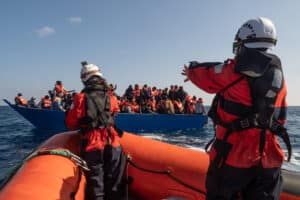
With our civilian rescue vessel, we quickly approach the location of the emergency and launch our rigid inflatable boats (RHIBs) along the way. These carry enough life jackets for all persons on board. We first speak with the people to calm them and prevent them from jumping into the water in panic, and distribute the life jackets. Small children and injured or unconscious persons are evacuated first and brought quickly to the ship, where the medical team cares for them. We then gradually transfer all persons from the boat to the ship.

On board, our doctors identify injured, ill, pregnant and otherwise particularly vulnerable individuals and begin treatment in our onboard medical facility. People often have burns from the fuel-saltwater mixture in which they have had to sit for hours or even days, and many are dehydrated. When we have particularly serious medical emergencies on board that cannot be treated at sea, we immediately call on the responsible authorities to arrange an evacuation. Every person on board receives a hygiene kit and a water bottle that can be refilled, and depending on the weather we distribute emergency blankets or warm blankets. We count the people and send a detailed report to the responsible authorities. Since 2018, it has become the grim reality that civilian rescue vessels must usually wait days or even weeks after a rescue before permission is granted to land at a safe port.

What happens to people after they have been rescued from distress at sea?

Under internationally applicable maritime law, people rescued from distress at sea must be brought to a safe port.7 A so-called “place of safety” must fulfil various conditions – for example, access to basic necessities and protection from persecution of the rescued persons must be guaranteed.8

In recent years, the Maritime Rescue Coordination Centre in Rome coordinated all rescues and assigned us and all other civilian rescue vessels at sea ports for disembarkation in southern Italy.

Since the change of government in Italy in mid-2018, rescue vessels were initially assigned ports with delays, and then for a period received no port assignments at all. The “Malta Declaration” adopted in September 2019 by Germany, France, Malta and Italy proposed a voluntary mechanism intended to contribute to the swift and reliable assignment of a place of safety.9

Nevertheless, it still takes days to weeks – as in the case of the merchant vessel Maersk Etienne10 – before vessels carrying people rescued from distress at sea are permitted to disembark at a European port. During this time, the governments of European member states negotiate which country will take in how many people through a so-called “relocation” procedure. As long as the intake quotas have not been determined, survivors must continue to wait on board the ships.

Reports from people rescued from distress at sea also show that they sometimes have to wait for months without further information for their transfer to their “receiving country,” and, for example in Germany, are quickly faced with rejection notices and the threat of deportation.11 Our demand for “safe ports” that are genuinely “safe” and offer people a prospect of remaining therefore continues to go unmet.


7 SAR Convention of 1979, Annex, Chapter 1, 1.3.2.

8 Further specification of a “place of safety” can be found in IMO Resolution MSC.167(78), adopted by the Maritime Safety Committee in 2004: https://wwwcdn.imo.org/localresources/en/OurWork/Facilitation/Documents/MSC.167%20(78).pdf

9 Joint Declaration of Intent on a Controlled Emergency Procedure – Voluntary Commitments by Member States for a Predictable Temporary Solidarity Mechanism, 23.09.2019, https://download.repubblica.it/pdf/2019/politica/joint-declaration.pdf (last accessed 09.02.2021).

10 https://www.theguardian.com/world/2020/sep/13/migrants-land-in-sicily-after-longest-standoff-in-european-maritime-history (last accessed 09.02.2021).

11 https://eu-relocation-watch.info/

Why don’t you bring rescued people to Tunisia?

Tunisia is disqualified as a safe place of disembarkation for people rescued in the central Mediterranean for several reasons:

Tunisia has no national asylum system. This means there is no national procedure for assessing refugee status and no legal framework for obtaining a residence permit.12 Asylum is a human right, and the non-existent possibility of applying for asylum therefore constitutes a violation of fundamental rights.

Furthermore, rescued people may belong to groups that face specific risks of persecution: Tunisian opposition figures fleeing the country itself, for example, face imprisonment and ill-treatment.13 Returning such people would blatantly violate the principle of non-refoulement.14 Tunisia also continues to criminalise same-sex relationships and must therefore be considered unsafe for LGBTIQ+ people.15

There are also reports of the arbitrary detention of migrants, who were neither informed of the legal basis or duration of their detention, nor able to exercise their right to legal representation and interpreters or to contact their consulate.16

There is also the risk of chain deportation for people who come ashore in Tunisia, as documented in the case of those on board the Maridive 601 in 2019.17


12 Global Detention Project 2020: Country Report Immigration Detention in Tunisia, Shrouded in Secrecy, https://www.globaldetentionproject.org/wp-content/uploads/2020/03/GDP-Immigration-Detention-in-Tunisia-March-2020.pdf (last accessed 29.01.2021).
13 Global Detention Project 2020: Country Report Immigration Detention in Tunisia, Shrouded in Secrecy, https://www.globaldetentionproject.org/wp-content/uploads/2020/03/GDP-Immigration-Detention-in-Tunisia-March-2020.pdf (last accessed 29.01.2021).
14 The principle of non-refoulement under the Geneva Refugee Convention prohibits the return of a person to a country where they face torture, inhuman treatment, or other serious human rights violations.
15 Human Rights Watch 2020: Tunisia: Two-Year Sentence for Homosexuality, https://www.hrw.org/news/2020/07/06/tunisia-two-year-sentence-homosexuality# (last accessed 29.01.2021).
16 Detailed information and reports can be found in the Amnesty International country report “Tunisia 2017/2018”.
17 See: https://www.theguardian.com/global-development/2019/aug/26/un-agency-accused-of-pressuring-refugees-to-return-to-bangladesh (last accessed 29.01.2021).

Why don’t you bring rescued people to Germany?

Most of our rescues take place in the Libyan search and rescue zone. However, Libya is not a safe place for disembarkation (see question above), nor does the Libyan Maritime Rescue Coordination Centre meet the international standards set by the IMO (International Maritime Organization).18 Furthermore, Malta has for some years kept its ports closed to civilian rescue vessels, meaning that we are ultimately assigned ports for disembarkation in southern Italy.

The journey from the central Mediterranean to Germany takes several weeks, and a rescue vessel is not a place where people can stay longer than necessary. Those rescued are often in critical health conditions and need to receive medical care and be able to rest on land as quickly as possible.

Following disembarkation in Italy, we call for rapid and solidarity-based distribution of people seeking protection across Europe. We acknowledge that Italy and Malta in particular, but also Greece and Spain, have been and continue to be left alone by the remaining European member states for too long. We demand swift distribution within the European Union, based on the needs and wishes of the individuals concerned, and one that offers them the right to remain.


18 https://www.bundestag.de/resource/blob/565680/314bc300770c6f5a3fe3b19b869f17f3/wd-2-103-18-pdf-data.pdf (last accessed 15.03.2021).

Why don’t you bring rescued people to Libya?

Libya is under no circumstances a safe place for people fleeing. Conditions in Libyan detention camps have been documented countless times, both by the UN and by numerous human rights organisations.19 In these detention facilities, people face the most serious human rights violations, including torture, abuse, sexual violence, and arbitrary detention.

International maritime law stipulates that people rescued from distress at sea must be brought to a safe place. This means that basic provision, access to basic medical care, and protection from persecution must be guaranteed.20

The Geneva Refugee Convention also prohibits returning people to a country where their life and liberty are at risk.21 The principle of non-refoulement is also enshrined in Art. 3 of the UN Convention Against Torture (CAT) and in Art. 19(2) of the EU Charter of Fundamental Rights.

Anyone who returns people to Libya is breaking international law. The European Court of Human Rights (ECHR) already condemned Italy in 2012 in the so-called “Hirsi Jamaa judgment” for returning refugees to Libya.22


19 https://www.amnesty.org/en/documents/mde19/3084/2020/en/; https://www.refworld.org/pdfid/5f1edee24.pdf (both last accessed 09.02.2021).

20 SAR Convention of 1979, Annex, Chapter 1, 1.3.2.

21 Article 33, paragraph 1, Geneva Refugee Convention 1951.

22 http://hudoc.echr.coe.int/eng?i=001-109231 (last accessed 09.02.2021).

What do you expect from European authorities and politicians?

Our core demands on the German federal government and EU institutions are directly implementable and would put an end to the politically motivated practice of allowing people to drown in the Mediterranean and ensure that existing law is once again upheld:

We demand:

  • The creation of safe and legal escape routes, so that people no longer have to put their lives at risk. #safepassage
  • The immediate cessation of funding and support for the so-called Libyan coast guard and the abolition of the so-called Libyan search and rescue zone. We strongly urge the EU to stop any policy aimed at circumventing international human rights and the Geneva Refugee Convention by outsourcing illegal pushbacks to the so-called Libyan coast guard, thereby violating international refugee and maritime law.
  • The establishment of a non-military European search and rescue operation with greater capacity and resources than the Mare Nostrum programme – even under Mare Nostrum, thousands of people died at sea.23 The European Union can coordinate and fund a civilian sea rescue mission in the Mediterranean – if the political will were there. A rescue programme could also be initiated by an affected EU member state by declaring the mass drowning of refugees a “crisis.” The EU Commission would then be obliged to provide assistance. The crisis response mechanism can be triggered either by the Council Presidency or after a member state has invoked the solidarity clause.24
  • The decriminalisation of flight and civilian sea rescue.
  • The evacuation of Libyan camps and resettlement in the EU. The EU must acknowledge its responsibility and stop the externalisation of the European border regime.
  • The restoration of open ports in Europe – a solidarity-based distribution of people based on the individual needs of those affected must take place on land and cannot be negotiated at the expense of people in need.
  • Reception in municipalities – solidarity cities and municipalities in Europe must be given the ability to make autonomous decisions about welcoming people.
  • As long as Frontex and EUNAVFOR MED exist, there must also be a transparent oversight mechanism that legally prosecutes the systematic human rights violations carried out in the course of their operations.


23 Mare Nostrum was a military-humanitarian sea rescue mission initiated by the Italian government, which operated from October 2013 to October 2014.
24 https://www.bundestag.de/resource/blob/684132/448a2469a2ed48a9d2710e9f795296af/PE-6-094-19-pdf-data.pdf (last accessed 09.02.2021).

“Those aren’t refugees, they’re economic migrants!”

People who are fleeing are first and foremost people seeking protection. People who are in distress at sea must be rescued under international law.25 A person’s story of flight is long, complex, and cannot be reduced to simple explanations. It usually begins long before people find themselves in Libya and we encounter them at sea. Once in Libya, they are in many cases victims of torture, abuse, and forced labour. The situation in Libya is without exit, making the crossing of the Mediterranean often the only way to escape these conditions.

At the moment of rescue, it is irrelevant why people undertake the crossing of the Mediterranean. The right to asylum is a human right. To uphold it, it must be ensured that every person has access to a fair procedure and can exercise this right. Such a procedure cannot take place at sea, but only on land.

Sea-Watch advocates for freedom of movement for all. Every person should have the choice of where they wish to be or not be. We emphasise the legitimacy of the most varied reasons for flight, including poverty, lack of access to medical care, war and violent conflict, persecution, and lack of prospects. So-called “economic migrants” often flee from a neocolonial policy of exploitation by the countries of the global north. The desire to live a self-determined and self-reliant life and to create one’s own future is legitimate. We reject the categorisation of people according to valid and less valid reasons for flight.


25 United Nations Convention on the Law of the Sea, Article 98, (1): https://eur-lex.europa.eu/LexUriServ/LexUriServ.do?uri=OJ:L:1998:179:0003:0134:DE:PDF

Don’t you support the business model of people smugglers?

We have already addressed the so-called pull factor argument in detail above. The only addition to make here is this: the best way to combat people smuggling is to create legal escape routes. This has been a core demand since the very beginning of civilian sea rescue. We advocate for people being able to flee via safe and legal routes, so that we are no longer needed and smugglers cannot sustain their business model due to lack of demand.

Anyone who is serious about combating so-called smuggling networks must advocate for safe escape routes. Everything else is smoke and mirrors.

Why don’t people fleeing choose the safer option of travelling to Europe by plane or ferry?

That is precisely our core demand: safe and legal entry routes to Europe for all people – not only for those who happen to have been born in a country with the right passport. However, people without a visa or residence permit cannot simply board a plane or ferry and legally cross borders. Legal entry options are almost non-existent. Applying for asylum is only possible within Europe, not at embassies or consulates abroad. The number of resettlement places available also bears no relation to actual need. Visas are often tied to high financial and bureaucratic requirements that cannot be met by people in acute emergencies. Added to this is the fact that administrative structures in war and crisis zones often no longer function reliably. People fleeing are therefore forced to attempt the Mediterranean crossing in order to find protection in Europe and exercise their right to asylum.

How can I support you without going on board?

We rely on donations to be able to save lives in the Mediterranean this year too. Recurring monthly donations in particular help us to plan our operations over the longer term. In addition to financial support, organisational help is also welcome. A great help is also spreading the idea of Sea-Watch among friends and acquaintances.

About “23 000 Lives” on Netflix

From July 17 on Netflix

Production & Cast

23 000 Lives, from director Markus Goller and screenwriter Oliver Ziegenbalg in collaboration with Michele Cinque, features a top-class cast: Louis Hofmann (plays Lukas Weiland), Mala Emde (plays Kitty), Katharina Stark (plays Nina), Frederick Lau (plays Head of Mission Sören), Maria Dragus (plays Captain Viola), Trevor Magaya (plays Lamin), Kathy Etoa, Felice, Saibon Wang, Joone Dankou, Merlin von Garnier, Luisa-Céline Gaffron and Omid Memar. Guest roles include Corinna Harfouch, Ulrich Matthes, Franka Potente, Katja Riemann, Frank Plasberg, Herbert Knaup and Eleonora Romandini.

Produced by Neue Flimmer GmbH (Christopher Zwickler) and Sunnysideup Film GmbH (Oliver Ziegenbalg and Markus Goller) in collaboration with Lazy Film. The production design and music are provided by Oscar winners Christian Goldbeck and Volker Bertelmann, with Frankie DeMarco as director of photography.

Netflix press release

What impact can a single person have? In a world full of crises, many feel powerless – convinced that individual actions can’t change anything.

The film 23 000 Lives, available worldwide exclusively on Netflix from July 17, shows that it is possible. 23 000 Lives tells the true story of a group of young people who wanted to change things. Under the name “Jugend Rettet” (Youth to the Rescue), they collected money, bought an old ship and saved the lives of 23,000 people in the Mediterranean – 23,000 reasons why a little courage and humanity can change everything. Then the ship was seized by Italian authorities. The accusation: facilitation of illegal migration.

About

Inspired by the true story of Jugend Rettet, 23 000 Lives focuses on a group of young people who no longer want to sit back and watch as countless people die in the Mediterranean Sea trying to reach Europe. Without any sea rescue experience, they start a crowdfunding campaign, buy an old ship and use it to save the lives of over 23,000 people. But what started as a shared mission driven by hope and determination soon tests their understanding of what is right and fair.